
Trip Info
-
Feb-May:Sep-Dec
-
Strenuous/very tough
-
5-7 Hours
-
6,461m (21,197 ft)
-
English, Deutsch, French, Chinese
-
Kathmandu
Overview
Mera Peak Climbing, the highest trekking peak, stands tall at the height of 6476 m from the sea level in the Mahalangur section, Barun sub-section of the Himalayas. Located in the isolated Hinku Valley towards the south of Mt. Everest, Mera Peak Climbing has three significant summits; namely Mera North (6476 m), Mera Central (6461 m), and Mera South at (6064 m).
Extensively explored by the British Expedition team, including Edmund Hillary, Eric Shipton, George Lowe and Tenzing Norgay, before as well as after the successful ascent to Everest, Mera Peak (North) was first climbed in 1975 by Marcel Jolly, G. Baus, and L. Honills. However, Mera Central was climbed in May 1953 by Col. Jimmy Roberts and Sen Tenzing.
The standard route to the summit lies towards the North and involves high-altitude glacier walking. A number of routes have been discovered to the summit of Mera Peak, out of which West and South facing ridges are a bit tougher, demanding technical skills in peak climbing while the route towards the North is easier and standard. Any keen trekker with experience in high-altitude trekking can opt for Mera Peak climbing as it is a technically straightforward ascent. The top of the summit offers magnificent vistas of Mt Everest, Mt. Makalu, Mt. Lhotse, Mt. Cho Oyu, Mt. Kanchenjunga, and other snow-capped peaks in the Khumbu region. The challenge that it poses is worth the reward it offers upon successful ascent to the summit.
The standard route takes the climbers through the Zwatra La Pass at 4160 m presenting the opportunity to get acquainted with the local culture, traditions, and lifestyle of the local Sherpas. You will also be mesmerized by the diverse ecosystem, floras and faunas, and unique landscapes as you move along. You will have an opportunity to witness the remoteness and serenity of the lesser-visited Hinku Valley. Expect fewer teahouses as compared to the numbers on the trail to Everest. You will be walking on rugged and steep paths, so make sure you are physically strong and mentally prepared for the exotic yet challenging trip to Mera Peak.
Itinerary
Upon your arrival the Tribhuvan International airport (TIA) in Kathmandu, you will be greeted by a representative from Nepal Wanders who will take you to our hotel. In the evening, there will be a welcome dinner in a traditional Nepali cuisine restaurant where you will be able to enjoy authentic Nepali meal with a brief cultural program. Overnight at hotel in Kathmandu
On the second day, we will complete all official formalities like obtaining permits to climb Mera Peak and other necessary documents. Our guide will take you around the city for general shopping. We will conduct a briefing in the evening and pack up everything for the trek and peak climbing.
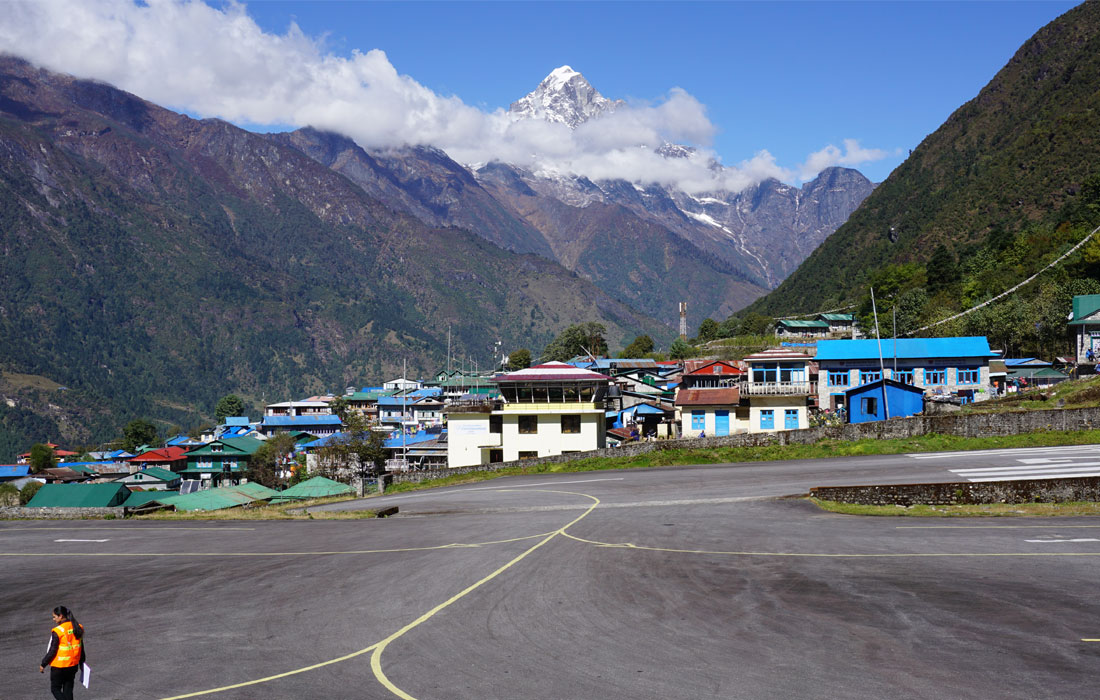
After early morning breakfast at the hotel, we take a short and scenic flight to Lukla, one of the highest altitude airports. As we land at Lukla, we will meet our local team members and porters who will carry our luggage to Chutenga. We will hike towards the south-east of Lukla that leads towards the Makalu Barun Conservation Area where we will obtain entry permits with nominal fees. We then follow a path that goes across small rivers and takes us past monasteries until we reach the Chutanga village. Overnight at Chutanga
From Chatunga, we head to our next destination Thuli Kharka via the Zatra La Pass. We walk past rhododendron forests and grazing pastures of yaks. It is a tough crossing, and we can feel the altitude. We climb the Kalo Himal ridge covered with stones and prayer flags. A couple of minutes later, we come to Zatrwa La Pass. The pass separates the Khumbu Valley and Hinku Valley. We stop for a while to take pictures and soak in the views.
Later we walk on a stony path to Thuli Kharka. Thuli Kharka, which means 'big meadow,' is surrounded by big boulders and stubby grass and shrubs. Used as a camp by yak herders, Thuli Kharka only has a couple of teahouses. On reaching Thuli Kharka, we head to a teahouse and take a well-deserved rest.
Overnight at a teahouse in Thuli Kharka.
We take the downhill trail to Kothe. En route, we enjoy outstanding views of the Hinku Valley, Kusum Kanguru, Peak 43, and the south face of Mera Peak. The trail goes through a beautiful forest of pine and rhododendron. If you are making this trip in spring, the rhododendrons will be in full bloom and the trail will look heavenly. At Kothe, you are in Hinku Valley. Make your way to a local teahouse and have a goodnight's sleep.
Overnight at a teahouse in Kothe.
Head on to the Upper Hinku valley. As we get higher, the treeline disappears. There are no major villages at this altitude, only kharkas or grazing meadows for yaks. On the way, we stop at Gondishung for tea and refreshments. Stunning views of Mera Peak, Charpati Himal, Kusum Kanguru, and Thamserku delight us.
We also visit Lungsumgba Gompa, a 200-year old Buddhist shrine. The local crew will pray for the well-being of the team and a successful ascent at the shrine. After an hour of walking, we reach Thaknak. From our teahouse, we savor a close-up view of Charpati Himal.
Overnight at a teahouse in Thaknak.
Today's trek takes us to Khare. It is a short but difficult hike as we are steadily gaining altitude. We ascend the Dig Glacier and weave past the glacial lake of Charpati Tal. We slowly descend to Dig Kharka. From here, we get magnificent views of Kyeshar Glacier, Mera Peak, and Charpati Himal. Climb up the Hinku Nup and Shar glaciers before finally making your way to Khare.
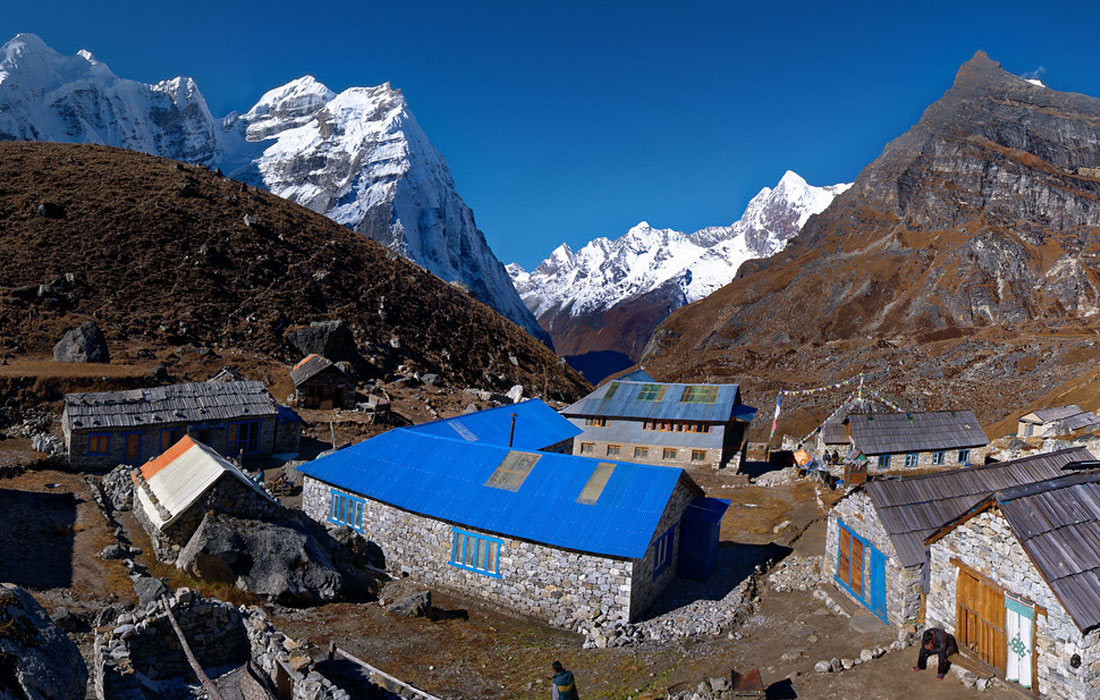
Khare, also called the Mera Peak Base Camp, lies at the foot of Mera Peak. There are a couple of teahouses and climbing gear and equipment outlets. After checking in at a lodge, enjoy the incredible view of Mera Peak's north face.
Overnight at a teahouse in Khare.
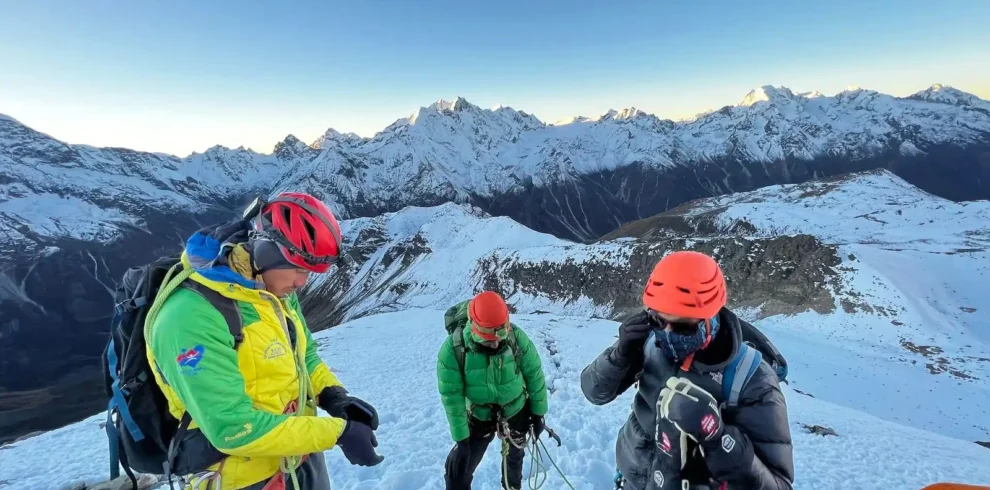
An acclimatization day before your climb lets you take part in pre-climb training conducted by our guides. You will get to try out your climbing skills before making it to the mountain. Ascend and descend on the rocky slope using harness and climbing equipment. Learn to make knots and the correct way to belay and rappel. If this is your first Himalayan peak, this training will be helpful for you as our experienced climbing guides will share some practical knowledge and really helpful tips that will help you do a safe climb.
There will be a final gear and equipment check, and you will pack for your summit push. There are gear and equipment rental outlets, and you rent out personal gear and equipment if you wish.
Please note that size 12 and above climbing boots are not available in Nepal. If you wear boots of that size, you need to bring them from home.
Overnight at a teahouse in Khare.
A steep and rocky path leads us to Mera La. We can enjoy splendid views of Mera Peak's three summits – Mera South (6,065m), Mera North (6,476m), and Mera Central (6,461m) and. The summit we are trying to reach is Mera Central. A straightforward ascent up the Mera Glacier brings us to Mera Peak high camp, and It is an easy hike with a gradual incline. Up to this point, there is no technical climbing. The only issue is high altitude and cold, which makes taking each step a struggle.
At Mera High Camp, comforting hot drinks and soup will be waiting for us prepared by our local crew. Mount Everest (8,848m), Kanchenjunga (8,586m), Lhotse (8,516m), Cho Oyu (8,188m), and Makalu (8,485m) - five of the 14 eight-thousanders are visible from the high camp. You can also enjoy amazing views of Chamlang (7,319m), Baruntse (7,129m), and Gaurishanker (7,134m).
Tonight we will be camping in tents - 1 tent per climber. Have an early night as we have a long day tomorrow.
Overnight at tented camp in Mera High Camp.
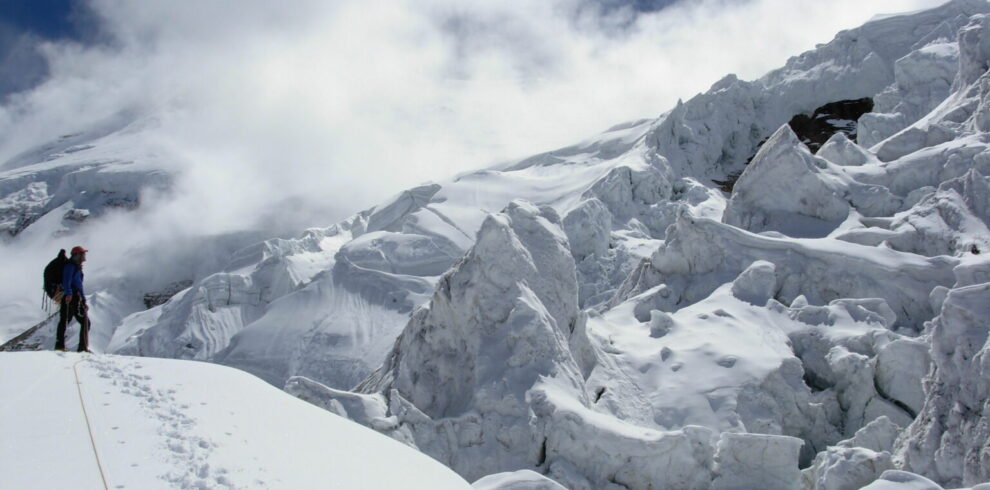
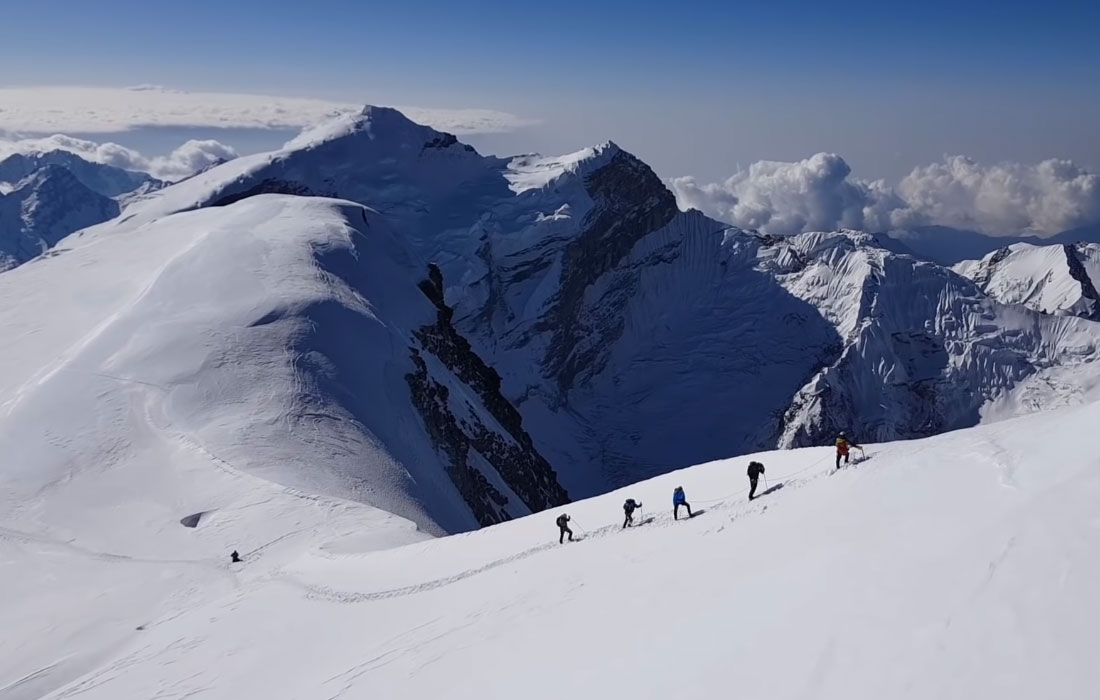
We get ready and hit the slopes at 2 AM. Our headlights are lighting the way we rope up and walk secured by man-rope. We cross the Mera glacier and climb gradually. The terrain is not that difficult to maneuver, but the cold air and low oxygen level slow us down. The last 40-50 meters to the summit is the hardest and the most challenging climb. On a steep incline, we use fixed rope and jumars to climb to the snowy dome of the Mera Peak summit.
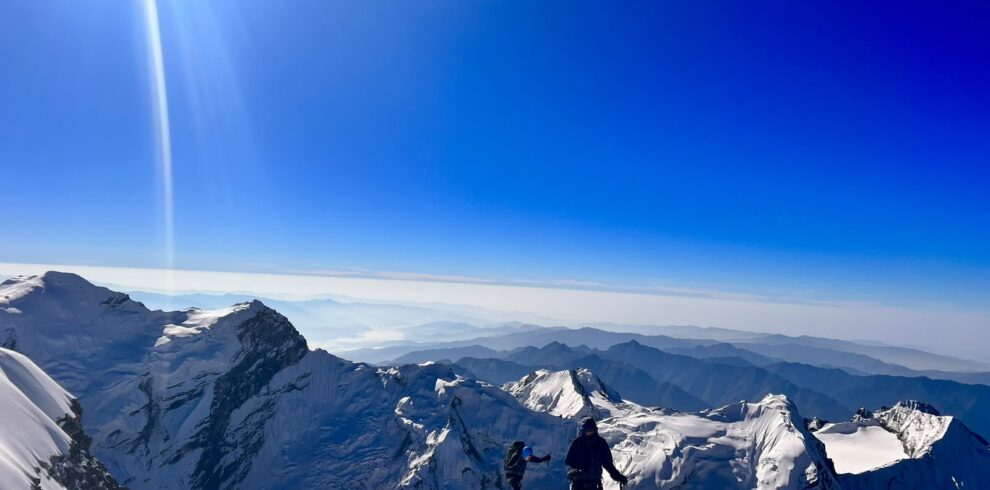
By 9-10 AM, we reach the summit. We celebrate our conquest while enjoying the close-up views of Mount Everest (8,848m), Makalu (8,481m, Kanchenjunga (8,586m), Lhotse (8,516m), and Cho Oyu (8,201m). After capturing this historic moment in our cameras and leaving mementos (if you brought any) at the summit, we head down to High Camp. We only spend 5 to 10 minutes at the summit.
At the camp, the local crew will greet us with a hot brew (tea/coffee) or soup. We rest for a while and make a quick descent after lunch. We trek down to Khare and head to a teahouse. I the evening, we celebrate our achievement and later have a good night's rest.
Overnight at a teahouse in Khare.
This is a reserved day for the summit if our summit bid on Day 9 gets canceled due to bad weather or member health problem. If everything goes smoothly, this day can also be used for emergencies like flight delays or unforeseen events that may lead us to cancel a day during our trip. If everything rolls out as planned, this extra day can be used to go a little bit slow and explore some more places on the trail. Or you can take this extra day in sightseeing in Kathmandu.
We will be retracing our steps back to Kothe. The majestic mountains are now hidden, obscured by the towering rocky cliffs. It’s going to be an extended day, however, if we haven’t utilized the contingency day on the 10th day, we have the option to use it on this day.
We make an ascent to the west of Hinku Valley, walking down a trail covered with rhododendron trees. It is an up and down trail. We arrive at Thuli Kharka, a summer camp of local yak herders, a final hike up a path.
Overnight at a teahouse in Thuli Kharka.
Leaving Thuli Kharka, we once again cross the Zatrwa La pass (4,600m) pass. In about 2 hours we reach the pass. The view is incredible, and we can view part of the trail that we crossed. Hinku Valley, Numbur Himal, Kongde, Dudh Kunda, and Khumbila look amazing. We walk to Lukla taking a downward trail.
At Lukla, we enjoy a hot shower and a good meal. In the evening we have a small party to celebrate the success of our trip. Our local crew join us and make our last evening in the mountains memorable.
Overnight at a teahouse in Lukla.
We return to Kathmandu by flight. After reaching the city, we head to our hotel and take a rest. You can spend the rest of the day relaxing at the hotel or exploring the city. You can walk down Thamel and shop for souvenirs. Local markets also lie within walking distance from Thamel.
Overnight at a hotel in Kathmandu.
Our representative will pick you up at the hotel and transfer you to international airport for onward journey.
Includes/Excludes
Cost Includes
- Meals: 10 breakfasts, 8 lunches ,9 dinners
- Transport: Comfortable van with A/C, One way flight to Pokhara
- Accommodation: Kathmandu (3 nights), Tea house (no facilities) (11 night), Pokhara (1 night)
- PERMITS : Expedition Royalty and a permit fee of Nepal Mountaineering Association (NMA) to climb Island Peak, Sagarmatha National Park, and Pasang Lhamu Rural Municipality entry permit and fee.
- GARBAGE MANAGEMENT : Stool Shipment Transfer & Garbage Deposit fees.
- INSURANCE : Medical & Emergency rescue Insurance for all involved Nepalese staff during the trek and expedition.
- MAP : Trekking and climbing map.
- DUFFLE BAG : One Nepal Wanders Treks’ Duffle Bag.
- MEMBER TRANSPORTATION : (Domestic Flight) Fly from Kathmandu – Lukla and while returning Lukla - Kathmandu, as per itinerary.
- EXPEDITION STUFFS TRANSPORTATION : All necessary expedition equipment transportation for all Members and Staff from Kathmandu to Lukla (by air cargo) and Base camp (by Porters / Yak) – While returning: Base camp to Lukla (by porters / Yak) and Lukla to Kathmandu (by air cargo).
- MEMBER LUGGAGE : Up to 25 Kg per member as personal baggage during the trek to be carried by porters.
- FOOD AND LODGING : 3 meals a day (breakfast, lunch, and dinner; including tea and coffee) along with accessible accommodation at Hotel/Lodge/Tent during the trek and at the Basecamp.
- DRINKING : Per day 2 Liters of boiled water per member to carry on the thermos.
- PORTER : Porters per member up to the Base camp and from the Basecamp (both ways).
- HIGH ALTITUDE CLIMBING SHERPA : 1 veteran and government-licensed climbing Sherpa per member (1 Member: 1 Sherpa), during the entire climb from Basecamp to the summit and back.
- ASSISTANCE : Climbing Sherpa to assist in carrying your gear to the high camps.
- CLIMBING SHERPA SALARY & ALLOWANCE : Climbing Sherpa’s Salary, Equipment, Food, and Clothing.
- OXYGEN BOTTLE (O2) : Oxygen bottles will be in stock at base camp in case of an emergency (with an appropriate charge).
- OXYGEN MASK & REGULATOR : 1 Set of Oxygen masks will be in base camp in case of an emergency.
- HIGH CAMP SERVICE (INFRASTRUCTURE AND LOGISTICS) : High Altitude Tent, Lights, Necessary cooking EPI gas, cooking pot, High food for a member, Sherpa, and other crews. Group climbing gears, fixed and dynamic rope during the climbing period as required.
- HIGH ALTITUDE TENT : Members will share tents in high camps (2 members: 1 tent).
- WEATHER FORECAST : Weather forecast report during the entire expedition.
- GUIDE : Local government licensed Guide (English speaking) during the trek and sightseeing in Kathmandu valley.
- VALLEY SIGHTSEEING : Sightseeing in Kathmandu Valley [Swoyambu (Monkey temple) and Kathmandu Durbar Square] by a professional guide.
- MEDICAL KIT : Comprehensive Medical kit for members and staff.
- CERTIFICATE : Island Peak climbing certificate issued by NMA (after climbing Island peak successfully).
Cost Excludes
- AIR FARE : International flight airfare (from and to Kathmandu).
- NEPAL ENTRY VISA FEE : Nepalese Visa fee is $50 USD for 30 Days.
- LUNCH & DINNER : Lunch & dinner during the stay in Kathmandu (also in case of early return from Trekking / Expedition than the scheduled itinerary).
- EXTRA NIGHTS IN KATHMANDU : Extra nights’ accommodation in Kathmandu. In case of early arrival or late departure, early return from Trekking / Expedition, domestic flight cancellation (due to any other reason) than the scheduled itinerary.
- INSURANCE POLICY : Insurance covering both medical and high-altitude evacuation costs (for the trip cancellation, interruption, high altitude rescue & air evacuation, medical treatment, repatriation, etc.) *Mandatory
- PERSONAL EXPENSES : Telephone Calls, Internet, Toiletries, battery recharge, hot shower, laundry, soft drinks, beers, and any Alcoholic beverages (during the trek and in Kathmandu but we will have soft drinks for members at base camp).
- PERSONAL CLIMBING EQUIPMENT : Clothing, Packing Items, Bags, Personal Medical Kit, and all kinds of Personal Trekking / Climbing Gear.
- TOILETRIES : Soaps, shampoos, toilet and tissue papers, toothpaste, and other items used to keep yourself clean.
- FILMING : Special Filming, Camera, and Drone permit fee.
- INTERNET SERVICE : Not included during the trek and the expedition.
- SUMMIT BONUS : Summit bonus for climbing Sherpa - Minimum 300 USD.
- TIPS : Calculate some tips for the high camp and other staff– Minimum 100 USD.
- EXTRA : Any other services or activities, which are not mentioned in the itinerary and other items not listed in the “Cost Includes” section
Embark on an exhilarating trekking journey that immerses you
It is a long established fact that a reader will be distracted by the readable content of a page when looking at its layout. The point of using Lorem Ipsum is that it has a more-or-less normal distribution of letters, as opposed to using ‘Content here, content here’, making it look like readable English. Many desktop publishing packages and web page editors now use Lorem Ipsum as their default model text, and a search for ‘lorem ipsum’ will uncover many web sites still in their infancy. Various versions have evolved over the years, sometimes by accident, sometimes on purpose (injected humour and the like).
Frequently Asked Questions
Mera Peak is located in the Khumbu region of Nepal, just east of the main Everest trail. The approach usually starts with a flight from Kathmandu to Lukla, followed by a trek through remote valleys and villages before reaching Khare, the base for the climb
Mera Peak has three summits:
• Mera North: 6,476 m (21,246 ft)
• Mera Central: 6,461 m (21,197 ft)
• Mera South: 6,065 m (19,898 ft)
Most climbers aim for Mera Central.
Mera Peak is classified as a “trekking peak” in Nepal. Technically, it is not very difficult because the standard route involves glacier walking and a gradual slope. However, the altitude of 6,461 m makes it physically demanding. Climbers need good stamina, acclimatization, and basic mountaineering skills (using crampons, ice axe, rope techniques).
The ideal seasons are:
• Spring (March – May): Stable weather, warmer days, excellent views.
• Autumn (September – November): Clear skies, cooler temperatures, and perfect climbing conditions.
Winter and monsoon climbs are possible but involve extreme cold, heavy snow, or rain.
Mera Peak is suitable for fit trekkers with basic climbing training. Prior experience with high-altitude trekking is recommended. Before the summit push, guides provide training on how to use crampons, ropes, and ice axe safely.
Yes. You can rent gear in Kathmandu and Khare, including crampons, ice axe, harness, helmets, boots, down jackets, and sleeping bags. Group equipment such as fixed ropes, ice screws, and snow bars are provided by the agency.
Summit push begins at around 2:00 AM from High Camp. The climb takes 6–7 hours to reach the summit and about 3–4 hours to descend back to Khare or High Camp. The slope is not very steep, but walking on snow and ice at high altitude requires endurance.
From the summit, climbers can see five of the six highest peaks in the world:
• Mount Everest (8,848 m)
• Lhotse (8,516 m)
• Makalu (8,481 m)
• Cho Oyu (8,201 m)
• Kangchenjunga (8,586 m, in the east)
This panoramic view is one of the highlights of the climb.
Yes, there have been casualties on Mera Peak expeditions. Although considered one of the safer trekking peaks, it still carries significant risks.
A 46-year-old South Korean climber died on the mountain after being caught in a severe blizzard. He likely died of hypothermia after becoming trapped while descending, and his body was recovered at around 5,800 meters. His Nepali guide was also missing but was later rescued.
While specific overall fatality statistics are not consistently published, the primary causes of death and serious incidents on Mera Peak are well-known:
Altitude Sickness: As a 6,476-meter peak, the altitude is the primary risk. Acute Mountain Sickness (AMS) can progress to life-threatening conditions like HAPE or HACE without proper acclimatization. It's common to see helicopter evacuations for altitude-related issues.
Extreme Weather: The weather on Mera Peak can change rapidly. Unexpected snowstorms, high winds, and extreme cold are major hazards that can lead to hypothermia, disorientation, and exhaustion.
Falls and Exhaustion: The final summit push is strenuous, often starting before dawn in freezing conditions. Fatigue can set in, leading to slips and falls on icy sections, particularly on the final summit ridge. Historical accounts also mention fatal falls during expeditions.
Overall, Mera Peak has a relatively low fatality rate compared to more technical Himalayan peaks, but the dangers are real and should not be underestimated
Yes. Mera Peak’s height of 6,461 m is well within the altitude sickness danger zone. That’s why itineraries include acclimatization days. Symptoms like headache, nausea, and fatigue should not be ignored. Guides monitor climbers closely and make decisions for safety.
Yes, having travel insurance with specific high-altitude mountaineering coverage is strictly mandatory for a Mera Peak expedition.
The insurance should cover:
- High-Altitude coverage: It must explicitly cover you for the summit altitude of 6476 meters
- Helicopter evacuation
- Medical and Repatriation: Covers costs for any medical treatment needed during or after the expedition and repatriation to your home country